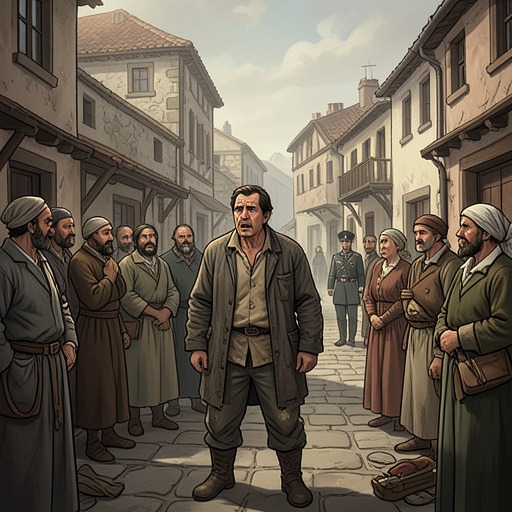
Rocho’s fugitive status
The PeasantsRocho’s fugitive status is defined by swift escape, improvised shelter, and the villagers’ willingness to protect him from the approaching gendarmes. At Antek’s house, concealment begins in the middle of ordinary work: Rocho disappears into the rye while Antek orders the household to keep quiet and continues sharpening his sickle as the authorities draw near. Later, guarded movements through Dominikowa’s home and a tearful farewell show that flight has become not only a matter of evading capture but also a wrenching departure from the people who have listened to him.
The gendarmes approach
The immediate danger reaches Antek’s house through a breathless warning: the gendarmes are already by Lipce Pond and are coming for Antek. Rocho understands that the pursuit is directed at him and lowers his head. His reaction is brief, but it marks a change in the room: the threat has arrived, and the household must decide what to do before the authorities reach the door.
Antek takes charge of the escape. He tells Rocho to go beyond the hayrick into the rye and hide in a furrow until summoned. The instructions are practical and urgent: Rocho must move quickly, and the field itself is to serve as cover. Without his cap or coat, he rushes through the orchard and disappears; the only sign of where he has gone is the swaying rye beyond the rick.
Rocho also entrusts papers to Józka, who is lying in bed, asking her to hide them beneath herself and say nothing. The scene does not explain their contents, but their concealment makes clear that the danger involves more than Rocho’s immediate physical escape. His flight leaves something behind that another person must protect.
Antek’s house as a place of concealment
Antek’s response combines careful household instructions with an outward show of routine. He sends Grzela away, tells Hanka to return to her work, and orders the others not to speak. Then he sits down again to sharpen the sickle, as if resuming the task interrupted by the warning. The appearance of calm is not ease: his heart is pounding, his hands tremble, and his eyes keep darting toward the approaching sounds.
The contrast makes the danger concrete. Antek continues to draw the blade against the stone evenly and accurately while dogs bark closer and marching feet, clattering swords, and voices announce the gendarmes’ arrival. His composure is an act sustained under pressure, not proof that the threat has passed. In the moment, practical work and deception occupy the same space: the sickle is still being sharpened, even as the house is being searched by sound for signs of the approaching force.
A guarded departure
Rocho later reaches Dominikowa’s home stealthily and shuts himself inside the storeroom to collect a few things. His movements are watched over by a small network: Jędrzych guards the road, Jagusia keeps watch in the yard, and Dominikowa listens anxiously from the chamber. The arrangement extends protection beyond Antek’s house. Roads, yard, and storeroom become parts of a coordinated effort to let Rocho move without drawing attention.
After spending time in prayer, Rocho emerges and speaks privately with Dominikowa before putting a bundle on his back. Jagusia insists on carrying it at least as far as the wood. Rocho accepts her help; after saying goodbye to Dominikowa, they travel through the orchard toward the fields. The scene gives his flight a deliberate, intimate rhythm: first concealment and collection, then a guarded walk away from the house, accompanied by someone who will not let him depart entirely alone.
Farewell to the village
Rocho’s final departure is accompanied by a gathering of villagers who listen to his unexpectedly momentous words with both fear and joy. Their response is described as heartfelt faith: his speech opens a vision of hope for them, and they sit in silence as if the words have bound them by a solemn vow. The passage presents his influence through the listeners’ reaction rather than through a detailed account of the speech itself.
When Rocho says it is time to go, he embraces and kisses each person. Jagusia sobs, while the men furtively wipe their eyes. Before leaving, Rocho kneels to pray, falls face down, and embraces the earth as though it were a mother he is leaving forever. His farewell thus joins religious gesture, attachment to the land, and separation from the community. The villagers part quickly, but the image of Rocho clinging to the earth makes the cost of escape unmistakable: he avoids immediate capture, yet leaves behind the people and place to which his final gesture remains bound.